add_audio
run.add_audio(key, audio, step=None, *, sample_rate=None, caption=None, time=None)
Logs a sound clip, such as a model's output for a speech or music task.
Parameters
- key (str): the name the audio is logged under.
- audio: one of
- a NumPy array or tensor of shape
(samples,)(mono) or(channels, samples), up to 16 channels; - the path of a WAV, FLAC, MP3, Ogg/Opus, M4A, AAC or WebM file;
- the bytes of such a file.
- a NumPy array or tensor of shape
- step (int, optional): the training step.
- sample_rate (int): samples per second. Required for arrays and ignored for files and bytes, which carry their own.
- caption (str, optional): a caption shown with the player.
Shape and dtype. The shorter axis of a 2-D array is taken as the channel
axis, so (samples, channels) works too. Floats are read as -1 to 1 and
clipped, and NaN becomes silence. int16 samples are stored as they are, and
int32 samples are scaled down to 16 bits.
Stored as 16-bit PCM WAV for arrays, written with the standard library's
wave module. That is 32 KB per second of 16 kHz mono. Files and bytes are
stored as they are, so log a FLAC or Opus file when size matters. The sample
rate, channel count and duration are recorded with each WAV clip.
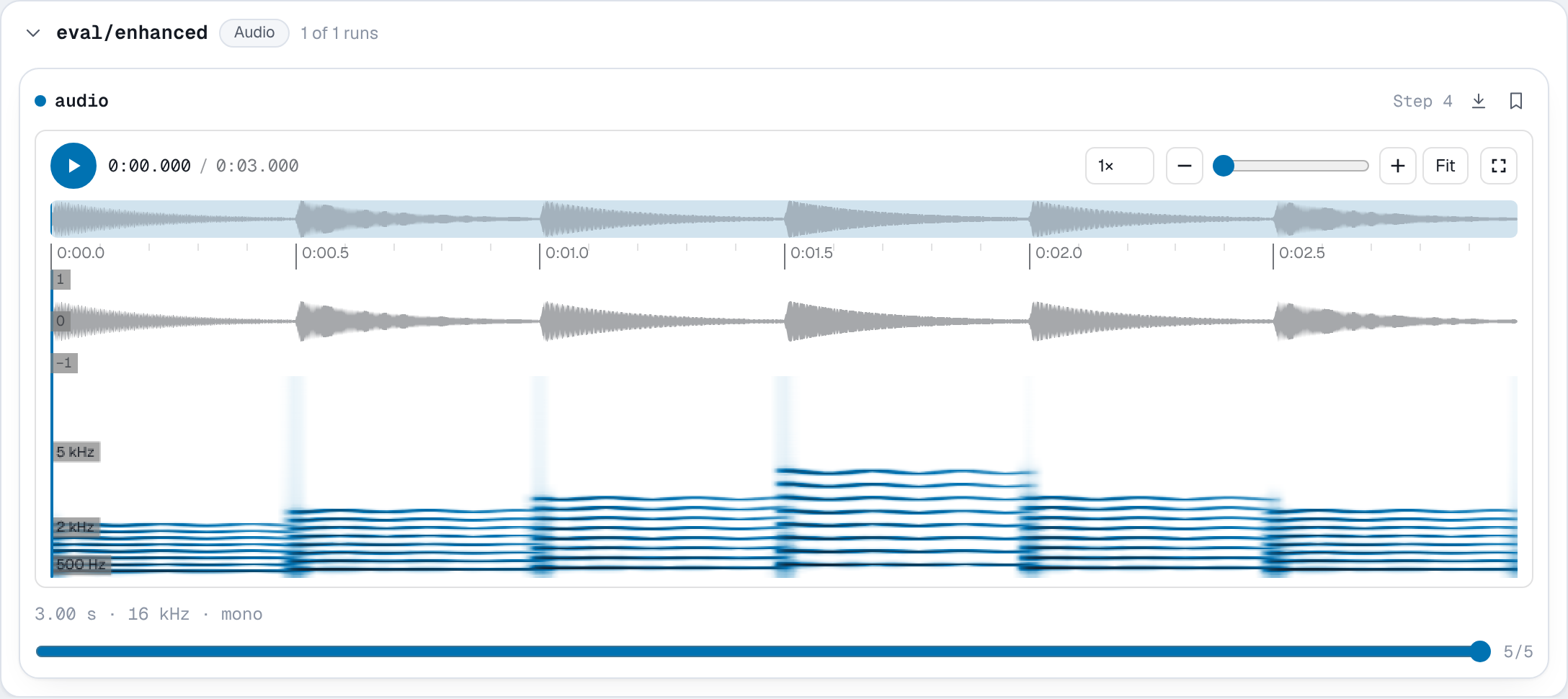
In the viewer each card has a player. The default waveform player shows a waveform and a spectrogram, zooms, loops a region, and keeps time-stamped notes. A simple player is one click away. See Audio for both. Audio is listed under Audio.
Example
import numpy as np

import nuboard as nb

run = nb.init("api-tour", run_name="audio")
rate = 16_000
t = np.arange(3 * rate) / rate

# A plucked arpeggio: six notes of half a second, each with 8 harmonics and vibrato
notes = np.repeat([262, 330, 392, 523, 392, 330], rate // 2)
f0 = notes * (1 + 0.015 * np.sin(2 * np.pi * 5.5 * t))
phase = 2 * np.pi * np.cumsum(f0) / rate
pluck = np.minimum(1, (t % 0.5) / 0.01) * np.exp(-5 * (t % 0.5))
clean = 0.25 * pluck * sum(np.sin(k * phase) / k for k in range(1, 9))
rng = np.random.default_rng(0)

for epoch in range(5):
    residual = 0.3 * (1 - epoch / 4) * rng.normal(size=t.size)
    run.add_audio("eval/enhanced", clean + residual, step=epoch, sample_rate=rate)

run.add_audio("eval/clean", clean, step=0, sample_rate=rate, caption="target")
run.finish()
Expected result