timer
run.timer(name, step=None, *, accumulate=None, all_ranks=None, sync=None) -> Timer
Times a part of the training code, such as an epoch, a validation pass or a callback, without decorators and without changing the timed code. The timer works as a context manager or as a start/stop handle:
with run.timer("train/epoch", step=epoch):     # a block
    train_one_epoch()

run.timer("val/epoch").start()                 # in one method...
run.timer("val/epoch").stop(step=epoch)        # ...and stopped in another

t = run.timer("ckpt/save").start()             # a handle, with the seconds back
save_checkpoint()
seconds = t.stop()
The name is the handle: run.timer(name) returns the same timer every time,
so a timer started in on_validation_start can be stopped in
on_validation_end without keeping it anywhere.
Parameters
- name (str): the timer's name, such as
"train/epoch"or"callbacks/Checkpoint.on_epoch_end". A/groups timers, as in scalar names. - step (int, optional): the step of the next
stop(orflush). Defaults to the step of the latestadd_scalarcall, as for system metrics; timers never move the step counter. - accumulate (bool): sum the spans and log their total once per
flush(), for a timer around every batch. Without it eachstop()logs one point. - all_ranks (bool): log from every rank, not only rank 0. Defaults to
nb.init(timing_all_ranks=...). See Distributed training. - sync (bool): call
torch.cuda.synchronize()at start and stop, so the time covers the GPU work and not only its launch. Only done when PyTorch is already imported; NuBoard never imports it.
accumulate, all_ranks and sync are fixed by the first call for a name;
a later call with a different value warns and keeps the first.
Returns a Timer with:
start(): starts it and returns the timer.stop(step=None): stops it, logs the span (or adds it to the total withaccumulate) and returns its duration in seconds.flush(step=None): withaccumulate, logs the summed spans as one point and resets; returns the total.elapsed,running: the seconds sincestart, and whether it is running.with timer: ...: start and stop; it stops even when the block raises.
nb.Timer.disabled(name) returns a timer that measures but logs nothing, for
code that hands out timers before a run exists or on a rank that does not log.
Mistakes never stop training. Starting a running timer restarts it, and
stopping a stopped one returns 0.0, each with a one-time warning. A timer still
running at finish() is dropped with a warning (a half-finished epoch is not a
real duration); accumulated spans not yet flushed are logged. A timer that logs
every stop many times per second gets a one-time warning suggesting
accumulate=True.
Raises ValueError when name is empty or contains a control character.
Stored as a scalar named timing/<name> (timing/<job>/<name> in a
helper job): the value is the duration in seconds and the
point's time is when the span started. An accumulating timer also writes the
number of spans it summed under a hidden key. See
Timing keys. A stop costs about a
microsecond and never blocks. To keep the word timing for your own scalars,
pick another prefix with nb.init(timing_prefix=...); a scalar logged with
add_scalar under the run's timing or system prefix gets a one-time warning.
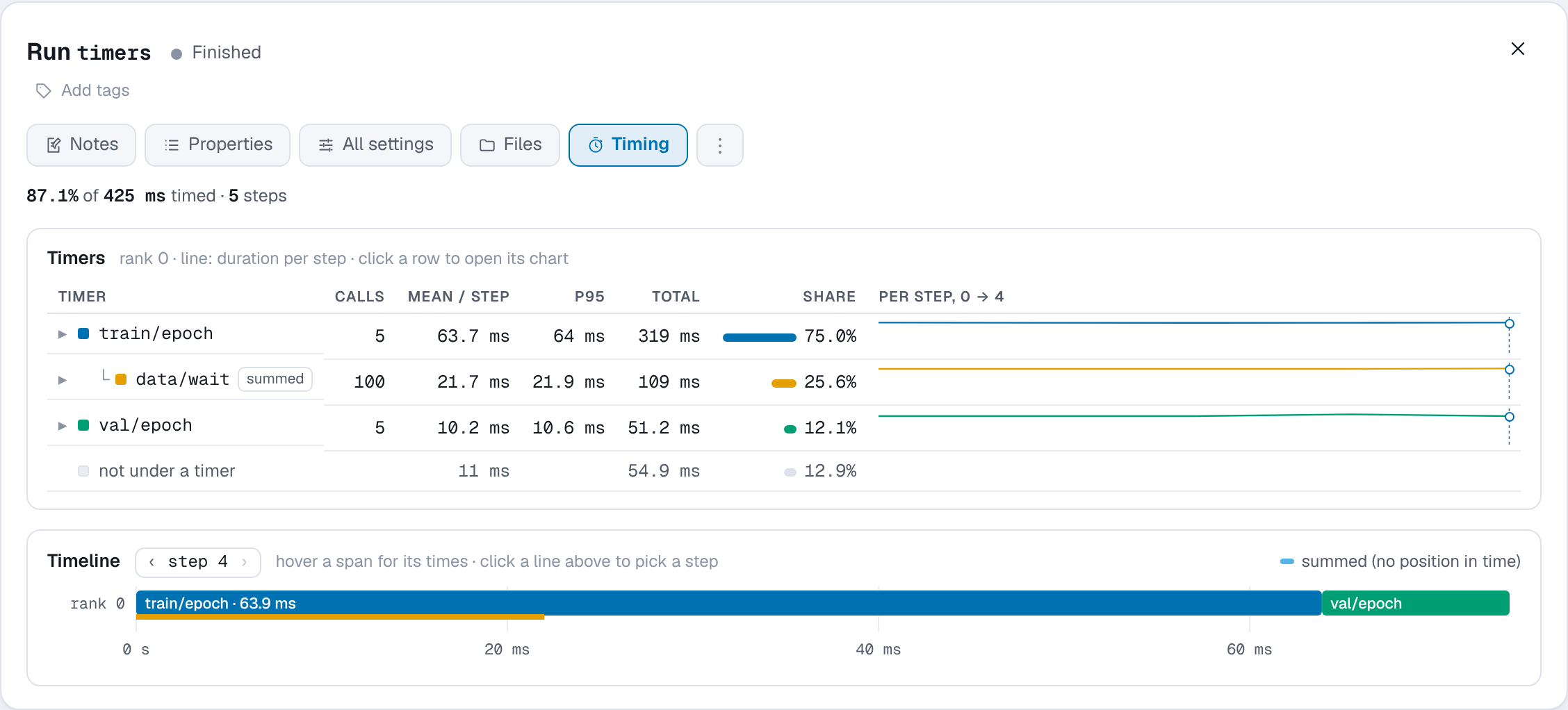
In the viewer timers are drawn in a timing section of the Charts page, with durations on the y axis, to compare runs. The Timing tab of the run details shows where one run's time went: each timer's calls, mean, p95, total and share of the run, its duration over the epochs, and a timeline of one epoch with a lane per rank.
Timing callbacks without editing them. A training framework that calls callbacks from one loop can time every one of them by wrapping that call once:
for cb in callbacks:
    with run.timer(f"callbacks/{type(cb).__name__}.{hook}", step=epoch,
                   accumulate=hook.endswith("_batch_end")):
        getattr(cb, hook)(trainer)
Hooks called on every batch accumulate, so they log one point per epoch after
a flush() (or at finish()).
Example
import time

import nuboard as nb

run = nb.init("api-tour", run_name="timers")
data_wait = run.timer("data/wait", accumulate=True)

for epoch in range(5):
    with run.timer("train/epoch", step=epoch):
        for batch in range(20):
            with data_wait:
                time.sleep(0.001)  # waiting for the next batch

            time.sleep(0.002)  # forward and backward

        data_wait.flush(step=epoch)

    run.timer("val/epoch", step=epoch).start()
    time.sleep(0.01)
    run.timer("val/epoch").stop()

run.finish()
Expected result